In today’s world, driven by instant messages, voice notes, and disappearing social media stories, the art of creating beautiful handwritten letters has quietly faded without even realising it.
Writing a letter once felt like an old-school, meaningful activity.
But fast forward to today, it may feel unusual, even unnecessary.
While growing up, I was too young to write letters in school or college, yet old enough to write, preserving golden memories that would never return and capturing the precious moment that strengthened bonds between friends in a profoundly personal way. In essence, that is what makes this practice special. A handwritten letter carries intention, effort, and emotion in a way digital messages never can. This practice was especially popular among millennials, particularly those born in the late 80s. It was a privilege to grow up during a time when handwritten letters were a creative way of passing the time.
Now, let’s take a look at the ways to make this practice special.
Table of Contents
Why Handwritten Letters Still Matter?
A handwritten letter is definitely a slower, more personal process that allows the writer to reveal their personality on paper more fully while holding a pen. It requires some thought to make it meaningful, unlike modern digital conversations, which are often rushed and fragmented.
The moment when your friend receives your letter, you’re offering something tangible that reminds them that someone took time out of their day to sit down to reflect on what a friend wrote just for them.
Today, writing a letter to a friend might seem out of place, yet receiving one can instantly lift someone’s mood, because it’s a thoughtful, handmade expression of care.
What Makes a Letter Last?
Think about the time when you made some unintentional mistakes that might have impacted your friend. Could be anything. You may have missed inviting them to a group hangout, or you cancelled the plans at the last minute without realising how it would make them feel.
Feel free to confess it and show genuine, heartfelt concern for those specific unintentional moments.
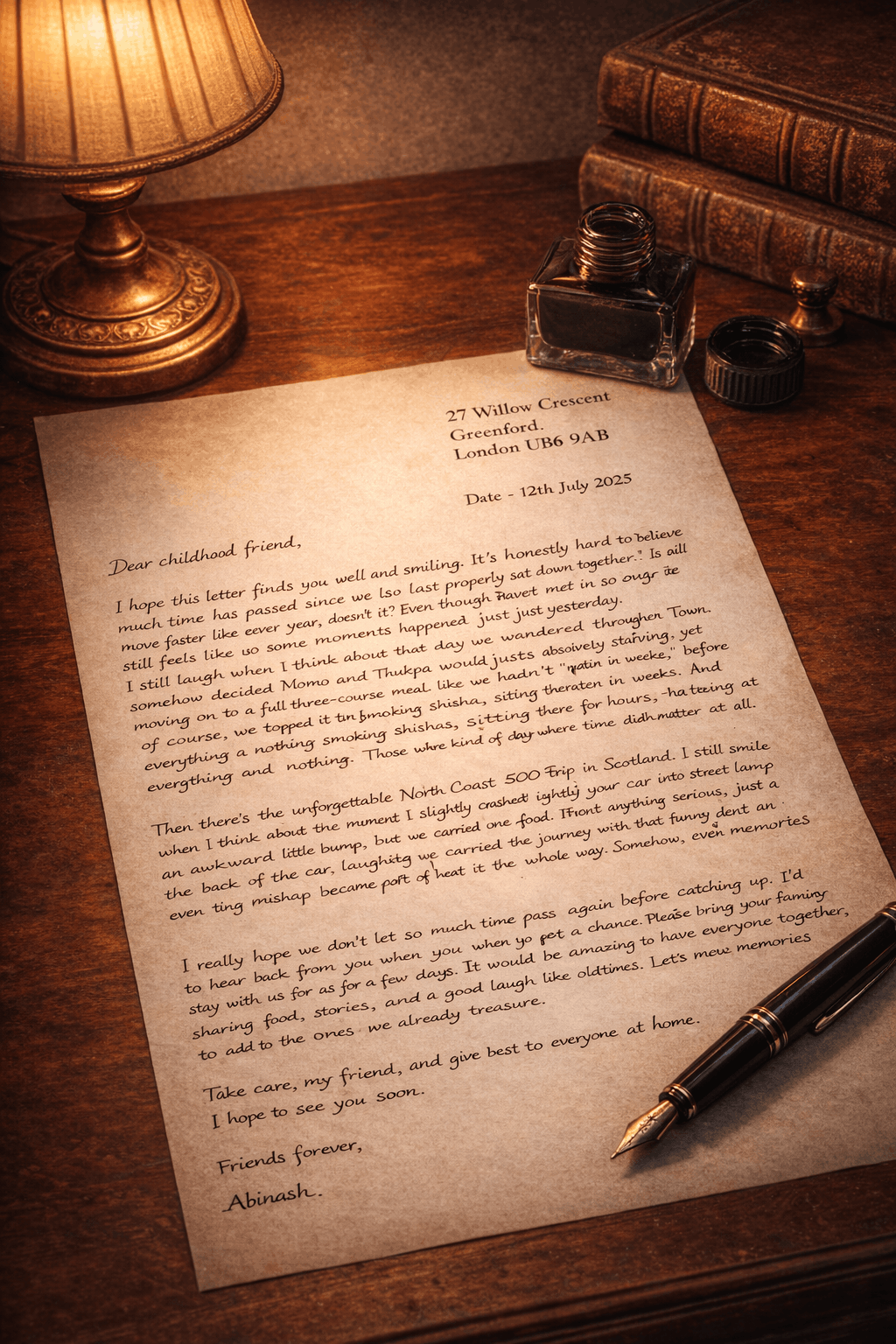
Talk about the most memorable time both of you have had. Maybe you guys wandered through Camden Town in London, trying MoMo and Thukpa at a Nepalese restaurant, followed by a three-course meal and finished it off with shisha.
Or you could have crashed your friend’s car into a streetlight while driving on a long trip to Scotland. Or you can even write about the moment where your actions didn’t land the way you intended. Even the moments where things didn’t go as planned often become the stories you can laugh about the most. You can be as silly or sentimental as you like. These memories, once written down, become something to cherish, pressed into paper and preserved in time.
A letter like this is usually written to someone who has been a constant in your life, someone you feel comfortable opening up to and building a deeper personal connection with.
Letter Writing Layout
Most of us have learned the basic layout of letter writing in school. If you’ve forgotten, don’t worry, because this is where I’ll be breaking it down into different parts. The secret to writing meaningfully is to keep it simple and minimalistic. Having a foundation in basic academic skills gives you the freedom to express your thoughts exactly as you wish. Let your voice come through the page.
Unlike academic or formal writing, you can skip introductions entirely because this is to a friend you already know.
Address
Place your address (street, town, and postal code) at the top left of the page, followed by the date. Little detail makes it readable.
Body
Begin with a warm opening. Acknowledge how long it’s been or reference your last conversation.
From there, move into shared memories and meaningful moments. Write each memory in a separate paragraph to keep the letter easy and enjoyable to read. Allow your thoughts to flow naturally, as if you were speaking to them over the phone. Write a letter that almost feels like having a long conversation with a childhood friend, sharing stories, emotions, and laughter, but in written form.
Closing
As you close the letter, express your hope to hear back from them. Offer a kind wish, or mention a plan you’d love to make together someday. End on a note that feels warm and genuine.
Signing off
Once you’ve finished the body of the letter, sign off on the left-hand side. A closing like “Friends forever,” followed by your name, works beautifully.
Final Thoughts
In the end, the lost art of letter writing isn’t gone; it’s simply waiting to be rediscovered.
In a time when communication is fast and fleeting, choosing to write a letter to a friend is a quiet act of care. Although AI is increasingly taking over many freelancing jobs in the modern world, improving writing skills still has a meaningful impact in contemporary life.
Letters definitely remind us that some things are worth slowing down for. And sometimes, the simplest things can bring a positive impact to your loved ones.